curvature of D-Wave chip for easier minor embeddability

The minor embeddability of a problem graph into the Chimera, Pegasus or Zephyr topology could be improved, not by better embedding algorithms, but by designing a "universal" chip with maximum tree-width subject to size, order, and technical constraints. The tree-width is indeed a measure of embeddability. A chip of maximum tree width would indeed boost the chances of successful minor embedding. Tree-width estimation is not an easy problem either, but recent advances in differential geometry--namely the correlation between the Ollivier-Ricci curvature and the tree-width (see Fig. 5 of paper also shown here)--along with the popularization of curvature methods opens the realm of possibly designing such a universal chip having maximally positive curvature. The remaining challenge is whether such optimization of the Ollivier-Ricci curvature (or other simplified methods such as the Forman-Ricci curvature) could be achieved on the D-Wave.
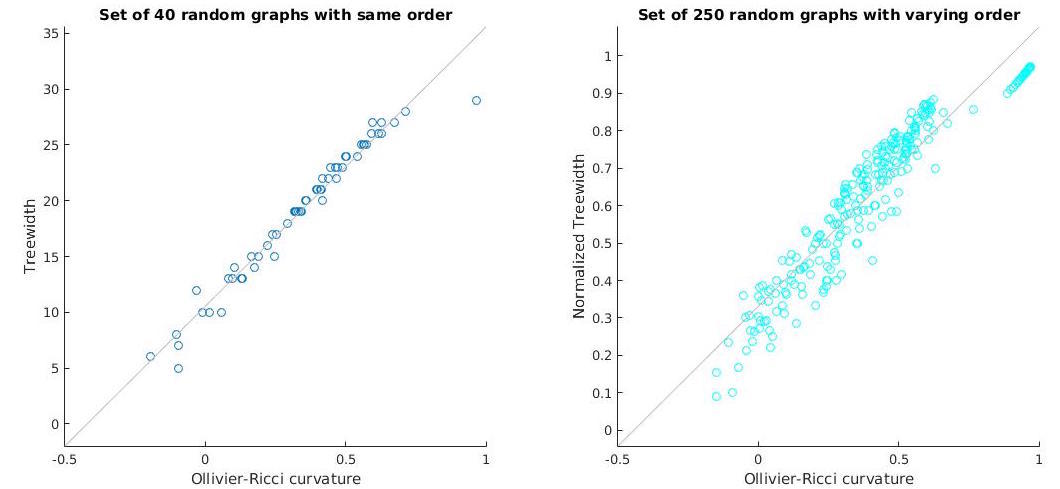
Here is the relevant paper:
Chi Wang, Edmond Jonckheere and Todd Brun, "Differential geometric treewidth estimation in adiabatic quantum computation," Quantum Information Processing, July 19, 2016. doi:10.1007/s11128-016-1394-9. The paper is accessible from https://ee.usc.edu/~jonckhee
Comments
Please sign in to leave a comment.