Difference between BQM, Ising, and QUBO problems?

I have seen the mathematical expressions for Ising and QUBO. Other than the fact that Ising deals with spin and QUBO works with binary, the expressions look identical to me. Is there a significant difference between the two problems? Also, how does BQM fit into this picture?
Ising problem:

QUBO problem:

Comments
Short answer:
Extension to differences between Ising and QUBO
Yes, the major difference between Ising and QUBO is that Ising deals with spin (-1, 1), while QUBO uses binary (0,1). While the two expressions are isomorphic, the choice of spin or binary can effect the way the problem can be expressed; namely, why QUBOs can always be fully expressed in both expanded and matrix forms, while Ising can be fully expressed in the expanded form, but not completely in the matrix form. Consider the following matrix multiplication,
If we expanded this matrix multiplication, we get
 (Eq. 2)
Now recall that we can express both Ising and QUBO problems in the following expanded form:
 (Eq. 3)
Recall with QUBOs, we are only dealing with binary values, 0s and 1s. Therefore if we have an x_i from the set {0,1}, then x_i is always equal to x_i^2. (i.e. 0=0^2 and 1=1^2). This means that a QUBO problem expressed as Eq. 3 (shown on the left hand side), can also be expressed as Eq. 2 (shown on the right hand side).

However, this property of x_i = x_i^2 is not true for spins. As in -1 does not equal (-1)^2. Therefore, the Ising problem can not be written completely in matrix form.

Proof that Ising and QUBO are isomorphic:

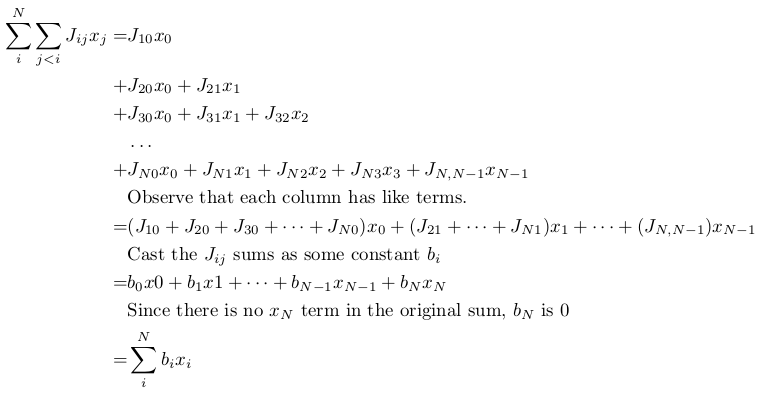
Third Term Expansion
We want the third term in terms of x_i. Let's expand and see what we can do.
Hello Melody Wong, thank you for taking time explaining above. What would be the benefit of using Ising, if not all problems can be represented using it, but using Qubo, you can do it? why bother then thinking Ising direction at all?
Hello Branislav,
Good question! QUBOs are easily expressed in Matrix form, as Melody explained above. However, both QUBO and Ising formats can be useful for different kinds of problems.
Take the first two Leap demos, for example. In the Factoring demo, it is useful to write numbers in standard binary notation (e.g. 101 = 5). Once our numbers are in this format, we can build a QUBO that multiplies these numbers, because the qubits in a QUBO can be represented as 0 or 1.
On the other hand, in the Social Network Analysis demo, we want to split people into two groups. We can say that a person (qubit) is on side A if they are +1, and side B if they are -1. It is useful that two people in the same group will always multiply to +1, because we can then "couple" two people together (make them tend to be in the same group) with J terms.
If you go through the Leap demos and click the "More Information" tabs, you can find more detail about how these examples make use of the Ising and QUBO formats.
Hi Branislav,
Thank you for your interest! To add on to what Luca has said, there are several reasons why Ocean (D-Wave's open source software) supports Ising.
(1) Quantum processor uses Ising under the hood
(2) Coefficient imbalance is more apparent in Ising
(3) Some concepts are more convenient to express in Ising rather than in QUBO
Please sign in to leave a comment.